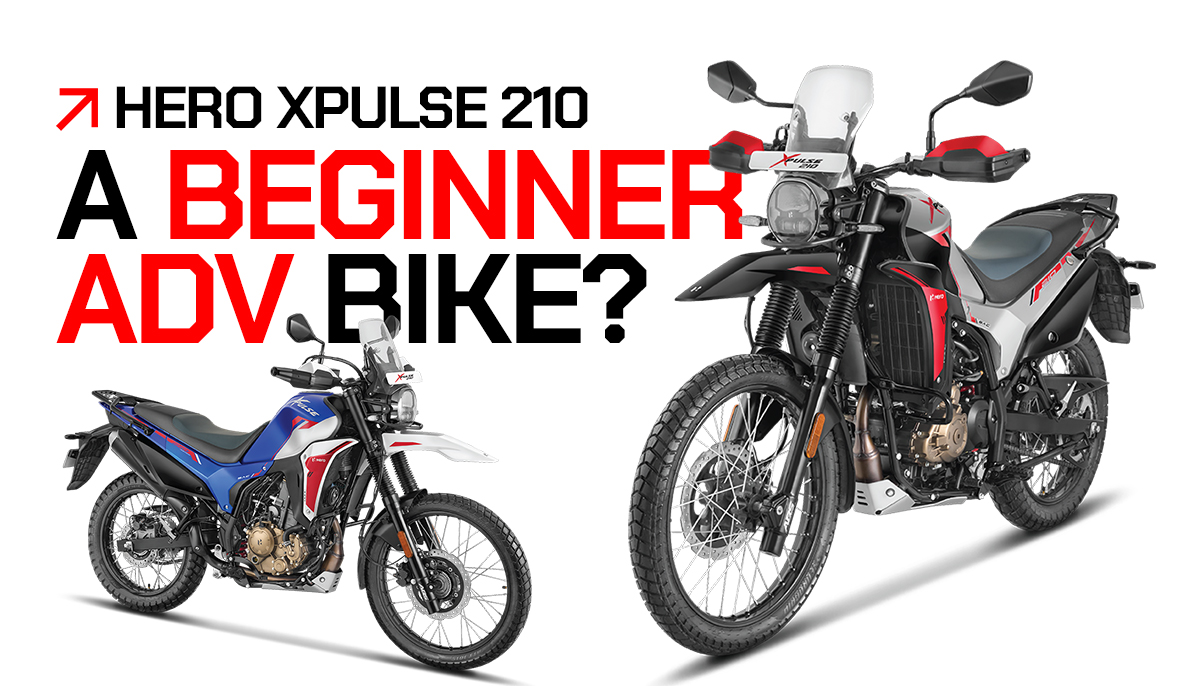
Hero Xpulse 210 in Nepal: Why It Makes Sense as a Beginner Adventure Bike





The entry-level adventure motorcycle segment in Nepal continues to be shaped by a single defining compromise: price.
Riders in this category typically want a machine capable of handling broken tarmac, rural roads, and occasional off-road use, while still remaining practical for daily commuting. However, in reality, most purchasing decisions in this space are dictated less by specification sheets and more by affordability.


The Hero Xpulse 200 established itself as one of the most influential motorcycles in this category. Introduced in Nepal in August 2019, and later updated with the 200 4V in April 2022, it effectively created a benchmark for accessible dual-purpose motorcycling.

While it was never positioned as a performance leader or a feature-rich product, it delivered just enough capability to make light adventure riding viable for a significantly larger audience. Over time, it became one of the most popular motorcycles in the segmet.
The Xpulse 210, its direct successor, now arrives as an much-needed update building on the same philosophy while attempting to address the most practical limitations of the previous model.

Platform and changes
At a glance, the Xpulse 210 retains the same fundamental identity as its predecessor — a lightweight, simple, dual-purpose motorcycle built around accessibility rather than performance.
The most significant mechanical change is the new 210cc single-cylinder, liquid-cooled engine producing 24.6 bhp and 20.7 Nm of torque, paired with a six-speed gearbox. Compared to the older 200cc air-cooled unit, the upgrade is most noticeable in mid-range performance and sustained highway riding.
This is not a dramatic shift in performance. However, it still prioritises ease of use over outright speed, and it is now better equipped to handle longer highway stretches without feeling as strained as the outgoing model.
Highway use
One of the most common criticisms of the Xpulse 200 4V was its limited highway comfort, especially for riders covering long distances.
The Xpulse 210 partially addresses this with the additional gear and improved engine refinement. Cruising at moderate speeds now feels less demanding, and overtakes require less planning compared to the previous model.
However, it still sits firmly in the entry-level displacement category. Riders expecting relaxed, high-speed touring capability will still find the platform limited compared to larger 250–400cc adventure motorcycles available in the market.
Practicality
Where the Xpulse formula continues to make the most sense is in its alignment with local road conditions. Even short routes can shift between smooth highways, broken tarmac, gravel sections, and construction zones.
In that context, the Xpulse 210’s long-travel suspension setup — 210mm at the front and 205mm at the rear — remains one of its most practical features.
The 21-inch front and 18-inch rear wheel combination further reinforces its ability to handle uneven terrain. While this does not make it a dedicated off-road motorcycle, it does make it more forgiving on surfaces where commuter street bikes struggle.
Features
Compared to the older model, the Xpulse 210 introduces a more contemporary feature package. A 4.2-inch TFT display with smartphone connectivity replaces the simpler instrument cluster, and full LED lighting is now standard.
Dual-channel ABS continues to be part of the package, with switchable functionality for off-road use. These additions improve usability and bring the motorcycle closer to current expectations in this segment.
Price and rivals
The Xpulse 210 is priced at Rs 5.99 lakh in Nepal, positioning it firmly in the entry-level adventure category.
Its closest direct rival in terms of displacement and intent is the KTM Adventure 250, priced at Rs 7.79 lakh. The KTM sits in a more performance-oriented and premium bracket, offering stronger engine output and a more refined overall package.
However, the pricing gap between the two models is significant.
For many first-time adventure buyers, the decision is unlikely to be based purely on performance figures. Instead, factors such as affordability, maintenance expectations, and intended usage tend to carry more weight. In that context, the Xpulse 210 occupies a lower entry barrier, while the KTM caters to a more performance-focused audience.
What it still misses
Despite the improvements, the Xpulse 210 continues to operate within the constraints of its category. The most noticeable miss is the lack of tubeless spoke wheels, which have become increasingly common in newer adventure motorcycles. For riders covering long distances on paved roads, this remains a practical inconvenience.
Additionally, while performance has improved, it does not significantly alter the motorcycle’s long-distance touring capability. The platform still feels best suited for mixed-use riding rather than sustained highway travel.
Where it fits in the entry-level ADV space
The Xpulse 210 does not significantly change the underlying characteristics of the platform. It remains a lightweight, entry-level dual-purpose motorcycle positioned around accessibility rather than outright performance.
The updates it introduces — including a liquid-cooled engine, six-speed gearbox, and revised equipment package — primarily improve highway usability and bring the motorcycle closer to current expectations in this segment.
At the same time, it retains the core characteristics that defined the previous model — simplicity, approachability, and mixed-surface performance.
At Rs 5.99 lakh, the Xpulse 210 occupies a clearly defined position in the market as an entry-level option within the adventure category, rather than a full-scale touring-oriented machine. Its relevance is likely to depend on how closely rider expectations align with the limitations and intended usage of the platform.
In that sense, the Xpulse 210 is best viewed as a continuation of the existing formula, with much needed revisions rather than a fundamental shift in direction.



Ather Nepal Opens 16th Experience Center in Surkhet

Royal Enfield Nepal’s ‘One Ride’ Draws Over 1,500 Riders Nationwide
Yatri P2 Pricing Explained: How Much Does Each Version Actually Cost?